
The wrestling world came together in mourning on August 23rd, 2023 as the passing of Wrestling Legend Terry Funk was publicly announced. Following this heartbreaking news, fans and wrestlers alike came together to share their favorite memories, matches, promos and moments from Terry Funk’s decades old career. Whether he was fighting Jerry “The King” Lawler in an empty arena, giving a tongue lashing to that egg suckin’ dog Dusty Rhodes in promos, or treating his body like a carnival past his 40s, everyone shared a fond memory. And its with this sharing of fondness that I wanted to talk about one of my absolute favorite pieces of Terry Funk’s career.
Well before the modern likes of Swerve Strickland, Myron Reed, and Chris Bey releasing their own music; and even before John Cena, Macho Man, and Hulk Hogan had full length albums to their name, Terry Funk released Great Texan. This gem of a City Pop album released all the way back in 1984 in Japan through the music label Invitation. Funny enough, despite being Terry Funk’s album, he only has writing credits on one song (and he was one of two writers on that track). This album was written by the combined efforts of Eiji Nakahira and “The Mouth of the South” Jimmy Hart. Amid a run in All Japan where he was facing the likes of Giant Baba, Bruiser Brody and Genichiro Tenryu, just how good of an album can one of wrestling’s greatest put out?

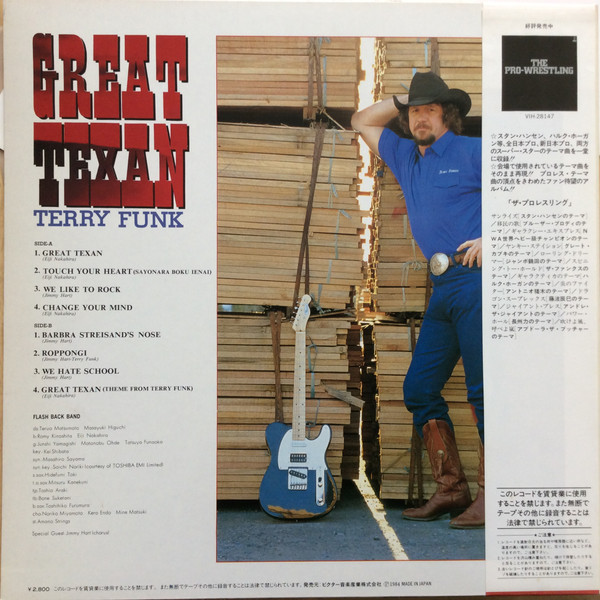
Front and back cover of the album.
Great Texan opens up in bombastic fashion with the titular track: Great Texan. You get a heart pumping track adorned with blaring saxophones, soulful backup singers, and a feature from Jimmy Hart (who did not actually write this track). This song feels like a theme song of sorts; introducing us to who Terry Funk is: a strong, mean, fighting machine. While the song does a great job of putting over Terry’s ferocity, he also personally gets across his softer, more tender side in between verses; a theme of duality that resonates throughout the remainder of this album. Its interesting to note here that the first and last song of this album are essentially the exact same song. However, the biggest difference between the two tracks is that the final track, Great Texan (Theme From Terry Funk) is just the instrumental version of this album opener. While some might consider that to be a waste of a track slot, I personally find it to be perfect for your karaoke needs!
From here, the album starts to showcase two different modes. The first of which comes with the next track: Touch Your Heart (Sayonara Boku Ienai). Contrasting to the fast paced rhythms of the album’s opener, we get more of a downbeat Love Ballad. Terry Funk spends the track lamenting about having to saying goodbye to his loved one. This theme of lost love becomes exclusive with the album’s ballads as the theme comes back around later in the album with the song Roppongi. Though where Touch Your Heart focuses more on coming to terms and saying goodbye, Roppongi is more so about reflecting sadly on a love already gone. Terry sings about being alone, as well as seeing his ex’s friend and choking up when she asks him to perform a song that his ex loved.
Now, in contrast to the previous songs discussed, this album also has a focus on Rock. And believe me, Terry likes to rock. He likes to rock so much so that he titled the third track, We Like to Rock. In this song, Terry talks about how he’s viewed as a “juvenile delinquent” because likes to cruise the streets, listen to Rock, party and pick up the ladies. The Funker’s delinquency is revisited later in the album on the seventh track, aptly titled We Hate School. This time, Terry is lashing out and rebelling against his teacher, his mother and even his girlfriend who are all on his back when he just wants to rock. Now bear in mind, despite the fact that its Terry Funk singing the lyrics, the songs become much more humorous when you consider the fact that at the time of recording/release, he was around 39 to 40 years old. Truly Terry Funk was still very young at heart.


These are real lyrics.
I wanted to purposely isolate these last two songs on the album’s eight track listing as these are certainly the standouts. The first one I wanted to talk about I actually found to be my unironic favorite on this album: the album’s fourth track called Change Your Mind. Where the previous songs have fallen into one of two molds (Rock or Ballads), both archetypes come together on this track to create a Ballad that manages to have much more pulse than the other two on the album. You get this funky backing track featuring some light strings, an absolutely kickin’ guitar, and a drum beat that will have you nodding along. While having this pulse, Terry is still showing his vulnerable side in nearly pleading with a loved one to stay and change their mind as the title infers. It honestly feels like the kind of song that could’ve been released in the 70s and rocked the clubs of the Disco era.
Of course, we have leave off with the Novelty Song that most people probably know this album for (if they know it at all): Barbara Streisand’s Nose. This Rock ‘n’ Roll tune features Terry chronicling an encounter with a woman who has many desirable features, yet the one that sticks out the most is her nose. Despite some bizarre mixture of celebrity features (Dolly Parton’s chest, Hershel Walker’s thighs and Liberace’s smile “that drives men wild”) Terry can’t help but fixate on her schnoz. At one point towards the end of the song, he even exclaims “Have you ever seen Barbara Streisand’s nose?!” While the goofy nature of this song sung by Terry Funk is the absolute standout, anyone with a keen ear can easily pick up that this song is very reminiscent of Michael Jackson’s Beat It which was only released two years prior. And with Jimmy Hart having writing credit on this song and his notorious ability to make legally distinct versions of popular tunes, it makes much more sense.
Naturally, Terry Funk himself did not have many good things at all to say about his album. In his book More Than Just Hardcore, he claimed that Great Texan “…contains some of the most godawful singing you’ve ever heard.” Terry also made the claim that “All the songs on that album had one thing in common—they all sucked.” Personally, I have to disagree with Terry to a point. Objectively, yes this album is certainly not going to be found amongst any of the best albums of all time, let alone of the 1980s. Terry Funk doesn’t quite sing on this album as much as he talks in rhythm for the duration. However, it is also far from the worst compilation of music out there. It would be one thing if Terry was given a bunch of instruments and let loose into a recording studio, but there was still competency behind this project. Accompanying Terry were sax players, guitarists, drummers and other musical talents that make each track enjoyable. Great Texan still has that distinctive 80s sound and prime City Pop tone that has found a whole new life and appreciation here in the 2020s.
If you want my take on this album, I would say you should absolutely listen to it. The album as a whole only runs around a half hour in length. Sadly, the flip side to this album being such a deep cut is that there is no readily available streaming option. And the only available copy for you to listen to is a direct vinyl rip with some skipping sprinkled in here and there in the front half of the album. Though in a weird way, I would say it actually adds to the experience; listening an old, worn, long obscured album thrown down on the turntable. At the end of the day, Terry Funk’s Great Texan is not some lauded classic or some cringy-bad ridicule piece. It is simply The Album of All Time.
 Top Rope Writing